Borda das falésias em Pourville, França (Bord des falaises à Pourville) - Claude Monet

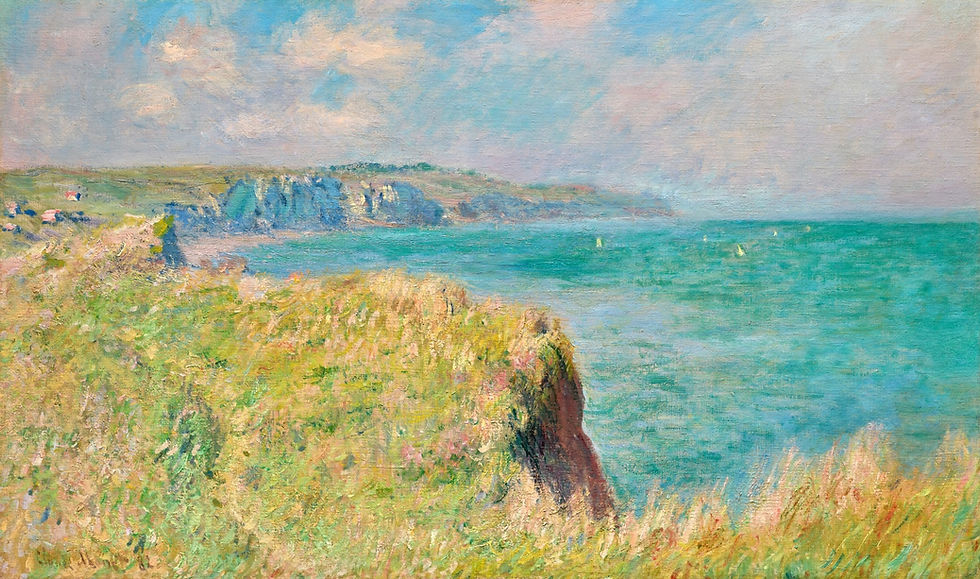
Borda das falésias em Pourville, França (Bord des falaises à Pourville) - Claude Monet
Pourville-sur-Mer - Hautot-sur-Mer - França
Coleção privada
OST - 60x100 - 1882
Giverny, Étretat, Fécamp, Dieppe, London, Venice, Rouen, Argenteuil are all places where Claude Monet left an indelible mark through his various stays there, immortalizing each location in his paintings. Pourville – a small fishing village on the outskirts of Dieppe located next to Varengeville on the so-called ‘Alabaster Coast’ in Normandy – was also one of Monet’s key destinations, that triggered the production of an important series of paintings. Monet did four trips to Pourville: February-March 1882, June-October 1882, February-April 1896 and finally in January-March 1897. He produced around 100 paintings during the two 1882 trips, and around 45 paintings during the 1896 and 1897 trips. Many of these Pourville canvases are held in major institutions around the world such as the Musée Marmottan (Paris), the Metropolitan Museum of Art (New York), the Art Institute of Chicago, the Cleveland Museum of Art, the Kreeger Museum (Washington D.C.), the Brooklyn Museum, the National Museum of Poznan (Poland), the Barberini Museum (Potsdam) or the Tokyo Fuji Art Museum, to name a few.
Around 30 Pourville paintings have been up at auction yet Bord des falaises à Pourville, painted during the second 1882 expedition, is the largest to come to the market since the mid-1980s. Most of Monet’s Pourville paintings were purchased by Paul Durand-Ruel, following the success of the Pourville landscapes presented at the 7th Impressionist Exhibition (March 1882) that was held in Paris between the two first Pourville journeys. Monet contributed a total of 35 paintings on that occasion, a third of which where Normandy landscapes, owing him the audience’s praises. Critic Ernest Chesneau wrote in Paris-Journal, ‘I stop before these admirable seascapes, in which, for the first time, I see rendered—and with such extraordinary power of illusion—the upswells and long descending sighs of the ocean, the rivulets of the eddying waves, the glaucous surface of deep water, and the violet hues of the low tide above its bed of sand’.
Monet's paintings of Pourville/Varengeville fall largely into three main groups: sweeping views from Pourville beach looking westwards along its distinctive clefted-cliffs which continue on to those of Varengeville; views from neighbouring beaches looking eastwards towards Pourville, and dramatic views looking out over the sea from the cliff-tops. Of these views, the first perspective, showing the wedge-shaped indented mass of the cliffs to the left, as depicted in the present work, Bord de falaises à Pourville, was Monet's favorite.
Full of enthusiasm and perhaps keen to escape from his new home in Poissy which he did not much like, Claude Monet set off in early February 1882 with the intention of painting the landscapes in and around the town of Dieppe. This was also a retreat from personal and professional pressures. His wife, Camille, had died three years earlier, and Monet had entered into a domestic arrangement with Alice Hoschedé (whom he would marry in 1892, after her husband’s death). France at that time was in the midst of a lengthy economic recession that affected Monet’s sales but also the finances of his dealer, Paul Durand-Ruel. In addition, the artist was unenthusiastic about the upcoming seventh Impressionist exhibition opening in March 1882—divisions within the group had become pronounced by this time—and he delegated the responsibility for his contribution to Durand-Ruel. Monet had met Durand-Ruel through the Barbizon School painter Charles-François Daubigny in London in 1870, where he had fled the Prussian War in France along with Camille Pissarro. By 1880, Durand-Ruel started buying Monet’s paintings and encouraged him to exhibit at the official Salon, rather than the Impressionist Exhibitions of 1880 and 1881. Yet Durand-Ruel was instrumental in bringing back the core Impressionist masters – Renoir, Monet, Sisley - to the 7th Impressionist Exhibition, that he financially supported and that he helped to organize in March 1882.
Although Monet admitted that Dieppe offered its fair share of interesting motifs to paint – ‘a superb sea but the cliffs are not as beautiful as those of Fécamp’ - he found the town itself to be more developed than he had anticipated and soon became bored, as he complained to Alice Hoschédé, ‘I walk about, I wander, I look at everything, yet nothing really seizes my imagination. If I had the money, I wouldn't hesitate to return to Fécamp.’ He decided barely a week after arriving there to check out from l’Hôtel Victoria in Dieppe and to move on to the small, picturesque fishing village-resort of Pourville located about five kilometres to the west: 'the countryside is very beautiful and I only regret not having come here sooner rather than wasting my time in Dieppe... one could not be closer to the sea than I am; the waves beat against the foundations of the house', Monet wrote to his partner, Alice Hoschédé, back in Poissy. Two days earlier, Monet had indicated to his partner the new address where he was staying in Pourville: : ‘M. Monet, chez M. Paul à Pourville par Offranville, Seine Inférieure’.
‘M. Paul’ was Paul Antoine Graff, an Alsacian chef, who headed the Casino-Hôtel in Pourville with his wife Eugénie. Their inn’s restaurant, A la renommée des galettes was widely popular and was renowned for the delicious ‘galettes’ they baked – eternalized in Monet’s painting Les Galettes, 1882, The National Gallery, London). Monet referred to the innkeeper as ‘Le Père Paul’ and incarnated him in a striking portrait of 1882 today housed at the Österreichische Galerie Belvedere, Vienna. Monet also paid tribute to Eugénie in his representation of the innkeeper’s wife holding her pet terrier, Follette, 1882 (Fogg Art Museum, Harvard University). Monet found himself in a warm and welcoming environment, transcribing his serenity and satisfaction to Durand-Ruel in a letter dated 21 February 1882: ‘I disappeared for a few days into a delightful little village in the vicinity of Dieppe. I have found many beautiful things there, so I am working tirelessly, although the weather has not always been on my side. In the end, I am quite pleased, and I believe you will find that I have made progress’.
He returned to Paris for the 7th Impressionist Exhibition and to Poissy to see Alice and the children. Buoyed by the praise he received on that occasion for his vividly-colored paintings of the sea, Monet soon planned to return to Pourville that summer to continue his painting campaign, but this time with his entire family: his two children Michel and Jean, Alice Hoschédé and her six children (Marthe, Blanche, Suzanne, Jacques, Germaine et Jean Pierre). Summer of 1882 in Pourville was overall a time of happiness for Monet, as his relationship with Alice, whose husband Ernest Hoschédé had been one of the artist's friends and patrons, was now in the open. From June to early October 1882, he rented a house called La Villa Juliette - today Villa Mon Coin - to which author Philippe Clochepin recently dedicated an entire book: La Villa Juliette, une muse normande à Pourville-sur-mer. Villa Juliette was perched high upon the western cliffs of Pourville. It commands, to the right, a sweeping view over the beach at Pourville and the unbroken line of chalk cliffs stretching away towards Dieppe and Le Tréport. To the left, the cliffs unfold in the direction of Varengeville, beginning with the secluded valley of Mordal. La Villa Juliette is visible on the right in the background of Monet’s painting Pourville of 1882. Durand-Ruel insisted on coming to visit his protégé in Pourville, finding a place to stay in Dieppe where he also greeted Pierre-Auguste Renoir that same summer. Working in this blissful climate surrounded by his loved ones, Monet revisited the cliffs and beaches that he had discovered earlier that year to paint several further canvases. Indeed, aside from his depictions of waterlilies at Giverny at the end of his life, Monet’s excursions along the Normandy coast in 1882 arguably represent one of the most productive stages of his career. It is also there that Blanche Hoschédé, aged seventeen, started painting for the first time alongside Monet.
In the present work, Bord des falaises à Pourville, Monet situated his easel on the western cliff of Pourville, close to Villa Juliette, oriented towards the majestic and iconic cliffs of Varengeville to the west. Although slightly smaller, its sister piece with the same title used to be part of the collections of the Metropolitan Museum of Art, New York before it was purchased at auction by the Barberini Museum, Potsdam in 2014. Similar to a photograph, the grassy edge of the cliff is in sharp focus, while the surface of the sea, the sky, and the cliffs of the bay in the distance are blurred. With a rich array of feathery brushstrokes of greens, pinks, whites, yellows and ochres, Monet succeeds in conveying the shimmering summer light in the foreground of Bord des falaises à Pourville. He captures the dramatic chalk cliffs that are so characteristic of the Alabaster Coast with vibrant streaks of different blues and whites, reflecting the relatively calm turquoise sea. Monet barely hints to human life, with three or four houses squeezed in the background on the far left, and suggests sailboats through the four or five white flecks in the sea. Although his famous series of the Haystacks or Rouen Cathedral, in which he sought to explore the shifting effects of light, came later, it is clear that he was already fascinated by the transient aspect of light and nature in the Pourville/Varengeville paintings of 1882, writing to Durand-Ruel: ‘I am becoming increasingly difficult to please: nothing satisfies me anymore, and nature is undergoing tremendous changes at this very moment…’In most cases, Monet completed a painting after working on it in ‘plein-air’ between 10 and 20 sessions and was very much dictated by the unpredictable Norman weather causing the ‘tremendous changes’ of nature. Bad weather considerably impacted Monet’s painting and consequently, his mood and self-confidence, as revealed in several letters to Durand-Ruel. Yet it is clear that by mid-1882, Durand-Ruel adamantly believed in Monet and his talent, always encouraging him and pushing him to pursue his paintings, writing in September 1882, ‘never have you been on a surer course or in finer creative form’.
It is not surprising that Monet decided to return to Pourville over a decade later in February 1896, explaining to Durand-Ruel that ‘I longed to see the sea again, and I am delighted to revisit so many of the places I painted fifteen years ago’. Monet therefore intended to paint again the same beaches, viewpoints and seascapes, but most likely sought to capture familiar scenes with a different light or atmosphere. Despite the bad weather and his disappointment with the Graff’s hotel that was newly owned following the couple’s respective deaths in 1891 and 1893, Monet stayed a couple of months. He even left with the aim to come back the following winter, making his last excursion to Pourville in January 1897.
A radical shift in his palette, from being dazzlingly naturalistic to blindingly unconventional, is clearly noticeable in A Cliff at Pourville in the morning, 1897 (Museum of Fine Arts of Quebec) as in The Cliffs of Pourville, Rough Sea, 1897 (High Museum of Art, Atlanta). As best summed up by Steven Z. Levine in his seminal book on ‘Monet and his critics’, ‘Monet's art was therefore at once the inevitable consequence of a historical evolution towards an ever more precise rendition of light in its ephemeral effects’. Trecho de texto da Christie's.
Nota do blog: Data 2026 / Crédito para Christie's.


Comentários